
IPTV vs Freeview: which is better in the UK?
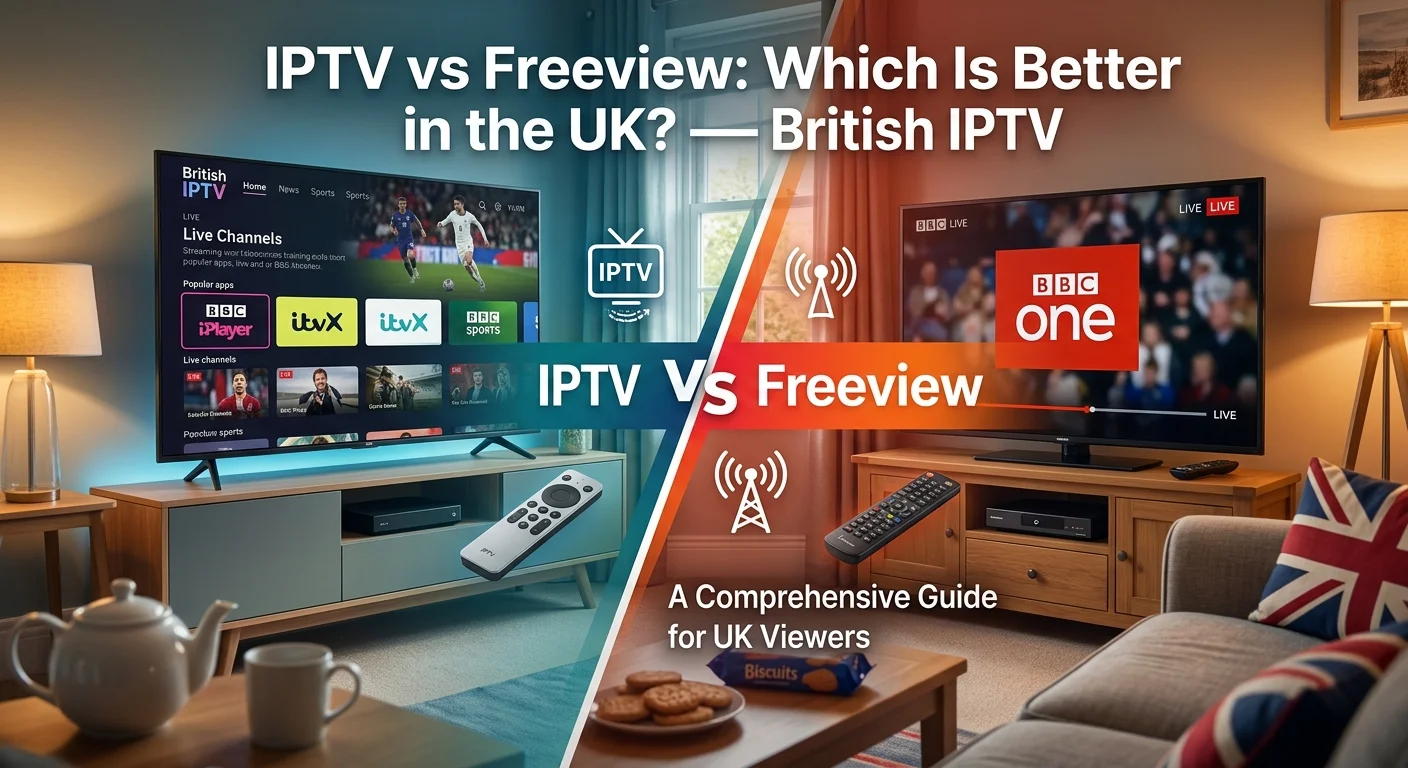
Almost every British home already has Freeview, which makes this the comparison that actually matters here — far more than the usual IPTV-versus-cable article written for an American audience. The honest answer is that they are not really competing. They cost different amounts, offer different things, and — crucially — they fail in completely different ways. That last point is the strongest argument in this whole guide, and it is why the sensible conclusion for most households is not one or the other.
What Freeview actually gives you
Let us be fair to it, because Freeview is genuinely good at what it does and any article that dismisses it is not worth reading.
- Free at the point of use. No subscription, ever. You need a TV Licence, but that applies to live television whatever the source.
- Around 70 standard channels, with a smaller number available in HD, depending on your region and reception.
- No internet required. It arrives through your aerial, entirely independent of your broadband.
- Built into virtually every television sold in the UK. No box, no app, no setup beyond a channel scan.
- Catch-up on compatible sets, through Freeview Play, which uses your internet connection for on-demand while keeping live channels on the aerial.
For a household that watches mainstream channels and nothing else, Freeview is entirely sufficient — and paying for anything more would be waste.
Where Freeview reaches its limits
Channel choice. Around 70 channels sounds like a lot until you look at what is actually there. Coverage of anything specialised — international channels, particular sporting categories, niche interests — is thin or absent.
No 4K. Freeview's ceiling is HD, and only on some channels. Broadcast spectrum is a finite physical resource, which is the practical reason Ultra HD has not arrived on terrestrial television and is unlikely to.
Reception is a lottery. What you receive depends on your location, your aerial's condition and which transmitter you are pointed at. Some areas receive fewer multiplexes than others, and nothing you do at home changes that.
Limited on-demand. Freeview Play covers the main broadcasters' catch-up services, and nothing beyond them. There is no film and series library in the sense that streaming users expect.
No international content. For anyone who wants channels from elsewhere — a significant number of UK households — terrestrial television offers essentially nothing.
What IPTV changes
An IPTV subscription delivers television over your broadband connection instead of through an aerial. In practice that means:
- A far larger catalogue — tens of thousands of channels rather than dozens, including international ones.
- An on-demand library of films and series, browsable like any streaming platform.
- 4K where the source supports it, which broadcast spectrum cannot deliver.
- Every device on one subscription — television, phone, tablet, laptop.
- No aerial dependency, which matters in flats, listed buildings and poor-reception areas.
The trade-off is that it depends entirely on a stable internet connection — roughly 8–15 Mbps per screen for Full HD, 25 Mbps and up for 4K. What that means in practice is covered in our guide to speed requirements. What a subscription includes and excludes is set out in what £24.99 actually gets you.
Head to head
Cost. Freeview wins outright — it is free. IPTV starts around £24.99, or roughly £4 a month on an annual plan. Against a traditional pay-TV package, though, both are inexpensive.
Channel choice. IPTV, by a very wide margin.
Picture quality. IPTV, where your connection supports it. Freeview tops out at HD; IPTV delivers 4K where the source exists. On a large modern television that difference is visible.
On-demand. IPTV, comfortably. Freeview Play covers catch-up only.
Simplicity. Freeview. It is built into the television and needs no credentials, no app and no account.
Reliability. Neither — and this deserves its own section.
The point most comparisons miss
Freeview and IPTV do not fail for the same reasons, and that is the most useful fact in this article.
Freeview is affected by aerial condition, weather, local interference and your distance from a transmitter. It is entirely unaffected by your broadband. If your internet goes down, Freeview keeps working.
IPTV is affected by your connection, your Wi-Fi and network congestion. It is entirely unaffected by weather, aerials or transmitters. If a storm takes out your reception, IPTV keeps working.
They are independent failure paths. Which means keeping both is not indecision — it is redundancy, and it costs nothing, because your aerial continues to work whether or not you use it.
This is why the practical answer for most UK households is not "which one" but "IPTV as the main service, Freeview as the fallback". Nothing needs disconnecting, and you keep a route to live television that survives a broadband outage.
Where Freely fits in
Worth a short note, since it changes the landscape slightly.
Freely delivers the main free-to-air channels over broadband rather than through an aerial, on compatible televisions. It is genuinely useful for homes that cannot put up an aerial at all.
But it does not change this comparison much, because it offers the same limited channel selection — it changes the delivery route, not the content. And by moving free television onto your broadband, it removes the independent failure path that made keeping an aerial worthwhile.
Who should stay on Freeview alone
Being straight about this matters more than persuading everyone.
- You watch mainstream channels and nothing else. Freeview covers it, and paying for more would be waste.
- Your broadband is genuinely poor and cannot be improved. Below roughly 8 Mbps of stable throughput, IPTV will frustrate you rather than serve you.
- You want zero configuration. Freeview needs no credentials, no app and no account, and that has real value.
Who benefits from adding IPTV
- You want international channels. Terrestrial television offers essentially none, and this is where the gap is widest.
- You follow specific sporting categories that Freeview covers thinly or not at all.
- You want a film and series library rather than catch-up only.
- You have poor reception or no aerial — a flat, a listed building, or a fringe area.
- You own a 4K television and want something to watch on it at that resolution.
- You are paying for a traditional package and using a fraction of it. This is where the money is.
Two things that apply to both
A TV Licence is required to watch or record live television in the UK on any device, however the signal arrives. Aerial, satellite, cable or internet makes no difference, and no provider can include it. The wider legal picture is set out in IPTV and UK law.
Neither replaces streaming platform originals. The exclusive productions each major platform makes for itself are not on Freeview and not in any IPTV catalogue. If one specific series matters in your house, keep that subscription.
How to try it without giving anything up
This is the genuinely risk-free approach, and it follows from everything above.
Do not touch your aerial. Take a short IPTV plan and run both side by side for a month. Freeview keeps working exactly as it does now, so there is nothing to lose and nothing to reconnect if you change your mind.
Test properly while you are at it — on a Saturday evening, on your actual television, for a sustained period rather than five minutes. The full method is in our guide to testing a service before you pay.
In short
Freeview is free, simple, needs no internet and covers mainstream viewing well. Its limits are channel choice, no 4K, minimal on-demand and no international content.
IPTV addresses all four, for around £4 a month on an annual plan, at the cost of depending on your broadband.
They fail differently, so keeping both is redundancy rather than indecision — and it costs nothing, since your aerial keeps working regardless. For most UK households the sensible arrangement is IPTV as the main service with Freeview underneath it.
More across our IPTV guides.
Frequently asked questions
They do different jobs. Freeview is free, needs no internet and is extremely reliable, but offers a limited number of channels and no 4K. IPTV offers a far larger catalogue and on-demand content, but depends entirely on your broadband. Many UK homes keep both.
No. Freeview runs through your aerial and is completely independent of anything you install on a streaming device. The two coexist without interfering, and keeping the aerial gives you a fallback when your broadband is down.
Not as a regular service. Freeview's highest quality is HD, and only a subset of channels broadcast in it. Broadcast spectrum is limited, which is the practical reason 4K has not arrived on terrestrial television.
Yes. A TV Licence is required to watch or record live television in the UK on any device, however the signal arrives. It applies equally to an aerial, a satellite dish and an internet stream.
They fail differently rather than one being better. Freeview is affected by aerial condition, weather and local reception, and is unaffected by internet problems. IPTV is unaffected by weather but depends on a stable connection. That difference is the argument for keeping both.
Freely delivers the main free-to-air channels over broadband rather than through an aerial, on compatible televisions. It removes the aerial requirement but keeps the same limited channel selection, so it does not change the comparison with a full IPTV subscription.