
The IPTV VOD library: how to judge it properly
Title counts are the easiest number in this industry to inflate, and everyone quotes them — us included. A six-figure figure tells you how many entries exist in a database. It tells you almost nothing about whether you will find something worth watching on a wet Tuesday. Here is what those numbers actually count, and five checks that reveal a well-kept library from a neglected one in about ten minutes.
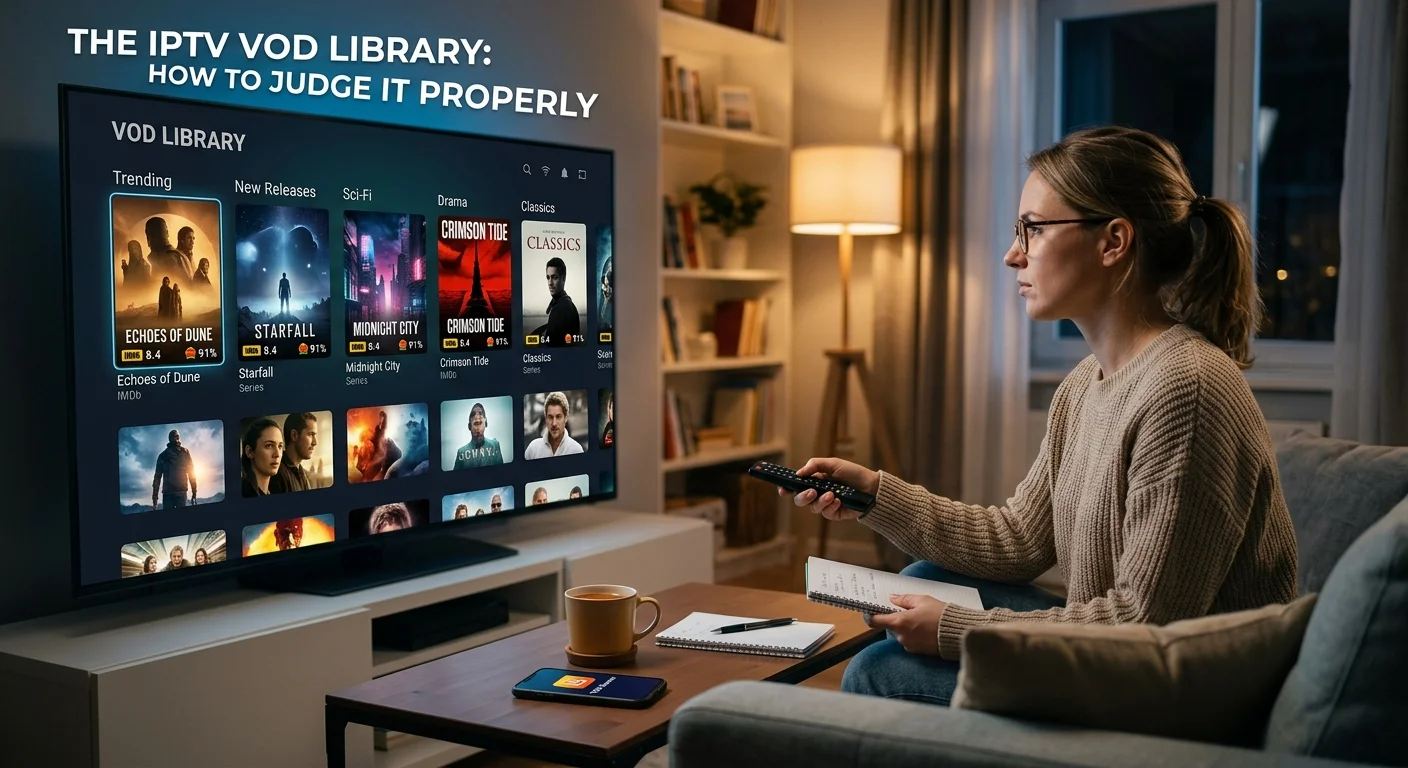
What the library is, and isn't
The on-demand library is a catalogue of individual files — films, series, box sets — that you browse and search by title. It exists independently of any channel's schedule.
That makes it a different thing from catch-up, which is a rolling archive of a live channel navigated by time through the guide. If you missed something that aired on Tuesday, catch-up is where to look. If you want a particular film, the library is.
Worth knowing because the two are often confused, and because their failures look nothing alike.
What a title count actually counts
Here is the honest version, and it applies to every provider in this market including this one.
A headline figure counts entries in a catalogue, not distinct works. Four things inflate it, all of them legitimately:
- Quality variants. The same film held in 4K, Full HD and a lighter version is three entries.
- Language versions. Original audio and dubbed versions are usually separate entries too.
- Episodes counted individually. This is the big one. A ten-season series with twenty episodes a season is two hundred entries. A handful of long-running box sets can account for thousands.
- Dormant entries. Titles that are listed but no longer play, because the underlying source has gone.
None of that is dishonest — it is simply what the number measures. But it means a six-figure count is not four times better than a five-figure one, and comparing two providers on that basis tells you nothing useful.
What matters instead is whether the library is maintained. A well-kept catalogue of fifty thousand entries is far more useful than a neglected one of two hundred thousand, and the difference is obvious within ten minutes of looking.
The five checks
Do these on any service, ours included, in the first days of a subscription while you can still change your mind.
1. Do titles actually play?
The decisive test, and the one people skip. Pick five at random — deliberately including one very old film and one recent release, since those are where dormant entries cluster — and press play on each.
Five out of five is a healthy library. Three or four suggests some drift, which is normal in any catalogue. Two or fewer means entries are being listed long after they stopped working, and the count you were quoted is largely fictional.
2. Is there artwork and a description?
Posters, synopses, year and cast do not appear by themselves — someone has to attach them. A library where most entries have artwork has been curated. A wall of grey placeholders with filenames instead of titles has not.
This is the fastest visual signal of effort, and it correlates strongly with everything else.
3. Does search return sensible results?
Search a film you know is popular. Then search a partial title, and a title with an unusual spelling.
Good search finds things by partial match and tolerates a missing word. Poor search demands an exact string and returns nothing otherwise — which, in a catalogue of this size, makes most of it unreachable in practice.
4. Are series complete?
Open a long-running series you know well and look at the seasons. Are they all there? Within a season, are episodes numbered continuously, or are there gaps?
Missing middle episodes are the single most annoying flaw in an on-demand library, because you only discover them four hours into a box set. Check before you commit an evening.
5. Is it organised at all?
Genres that mean something, a recently-added section, and the ability to sort. Without those, a large catalogue is a wall rather than a library — everything is technically present and nothing is findable.
Where 4K genuinely lives
Something worth knowing, because it is the opposite of what most people assume.
Live channels can only be delivered in the resolution they were produced in, and most British broadcast television is made in HD or Full HD. The on-demand library is different: those files are encoded independently of any broadcast, so this is where 4K actually exists in practice.
Which means the library is the right place to test picture quality if that matters to you. It also means a service promising 4K across every live channel is describing something that cannot be done, whereas 4K on a substantial part of the on-demand catalogue is entirely realistic.
Subtitles and audio in the library
On-demand content generally carries plain timed subtitles, which almost every player handles without difficulty — unlike live channels, which use broadcast formats that trip up many apps. If subtitles work on films but never on live television, that difference is why, and our guide to why IPTV subtitles don't show explains it properly.
Audio tracks work the same way: a film may carry several, and the player will not always default to the one you want. Worth checking the track selector before deciding a title has the wrong language.
Resume, and why it matters more than you'd think
A feature nobody mentions when comparing services and everybody misses when it is absent: does the library remember where you stopped?
Proper resume support means a "continue watching" row, a saved position per title, and — ideally — that position carried across your devices, so you can start on a tablet and finish on the television.
This depends on the player as much as the service, so if you are missing it, try another app before concluding the library is at fault. Our comparison of IPTV player apps and which suits which device covers which handle it well.
Libraries move, and that's normal
An honest expectation to set: catalogues are not fixed. Titles appear, and titles disappear, because the underlying sources change over time. Every provider is subject to this.
What you should reasonably expect is not permanence for any particular film — nobody can promise that — but that the overall coverage stays stable, that dormant entries get cleared out rather than left to accumulate, and that new material appears regularly. A library that only ever shrinks is a library nobody is tending.
Checking the recently-added section tells you this in seconds. If the newest additions are months old, that is your answer.
What a library can't be
Two limits worth stating.
It is not a guaranteed source for one specific thing. If you are choosing a service because you want one particular title, ask before you buy rather than assuming a large number implies it. A count of entries is not a promise about any of them.
It is not the same as the live channels. Some households barely touch the library and live entirely on live television; others are the reverse. Work out which you are before weighing up services, because it changes which parts of the offer actually matter to you — something we go into in our guide to what a UK IPTV subscription actually gets you.
In short
Title counts measure entries in a database, inflated legitimately by quality variants, language versions and — mainly — individual episodes. A six-figure number is not four times better than a five-figure one, and comparing providers on it tells you nothing.
Judge maintenance instead. Play five titles at random including one very old and one very recent; check for artwork and descriptions; test the search with a partial title; look for gaps in a long series; and see whether anything has been added recently. Ten minutes, and you will know more than any headline figure could tell you.
And do it in your first week, while a guarantee still applies. A library is one of the few parts of a service you can assess completely on your own, without asking anyone to take your word for anything.
Frequently asked questions
They count entries in a catalogue rather than distinct works, which is a legitimate measure but not a useful comparison. Quality variants, language versions and individually counted episodes all inflate the figure — a ten-season series with twenty episodes a season is two hundred entries on its own. Judge maintenance instead of size.
Five checks take about ten minutes. Play five titles at random including one very old and one recent; look for artwork and descriptions rather than filenames; search a partial title; check a long series for missing episodes; and see whether the recently-added section has anything new in it.
The library is a catalogue of individual files browsed and searched by title, independent of any schedule. Catch-up is a rolling archive of a live channel, navigated by time through the programme guide and only a few days deep. Use catch-up for something you missed on a given evening, and the library for a specific film.
Because the underlying source has gone while the catalogue entry remains. Some drift is normal in any library. What matters is the proportion — three or four out of five playing is unremarkable, two or fewer means dormant entries are being left to accumulate and the quoted count is largely fictional.
This is where 4K genuinely lives. Live channels can only be delivered in the resolution they were produced in, and most British broadcast television is made in HD or Full HD. On-demand files are encoded independently, so a substantial 4K catalogue is realistic — unlike 4K across every live channel, which is not.
It depends on your player as much as the service. Good resume support means a continue-watching row, a saved position per title, and ideally that position following you between devices. If yours does not do it, try a different player before assuming the library is at fault.