
Paying for IPTV in the UK: which method protects you
Nobody thinks about this at the checkout, and it is the decision that matters most if anything later goes wrong. Card, PayPal, bank transfer and cryptocurrency differ enormously in what you can recover — from a statutory right that makes your bank jointly liable, all the way down to no recourse whatsoever. Here is what each one actually gives you, and the threshold that decides whether the strongest protection applies at all.
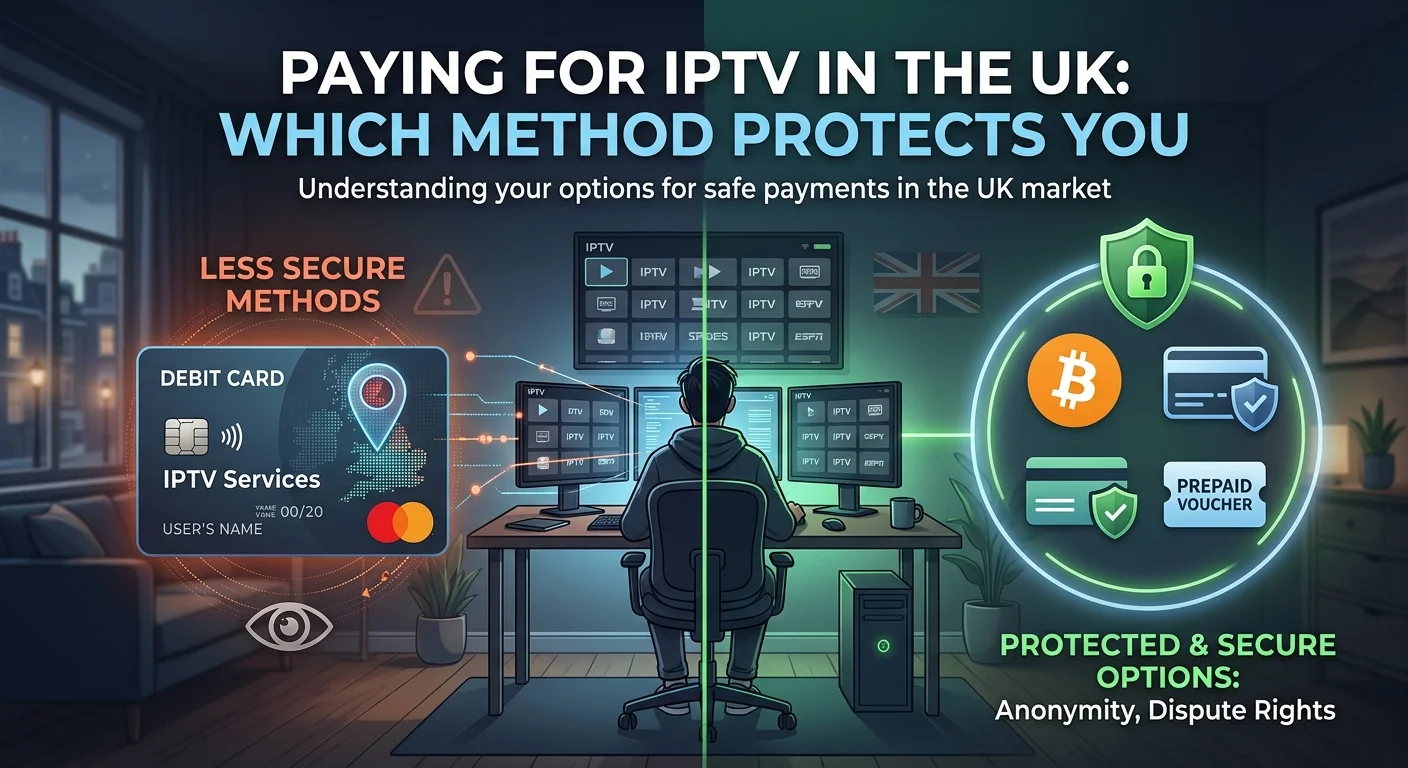
The short version
| Method | What protects you | Strength |
|---|---|---|
| Credit card, £100+ | Section 75 — a legal right | Strongest |
| Credit card, under £100 | Chargeback only | Moderate |
| Debit card | Chargeback only | Moderate |
| PayPal | Its own buyer protection scheme | Moderate, with conditions |
| Bank transfer | Nothing for a quality dispute | Weak |
| Cryptocurrency | Nothing at all | None |
The gap between the top row and the bottom two is not a matter of degree. One gives you a legal claim against a regulated institution; the other gives you a receipt and good wishes.
Section 75: the strongest protection, and its threshold
Section 75 of the Consumer Credit Act 1974 is the most powerful consumer protection in British retail, and most people have never heard of it.
When you pay by credit card for something costing between £100 and £30,000, your card provider becomes jointly and severally liable with the seller for breach of contract or misrepresentation. In plain terms: if the seller fails to deliver what was promised, you can claim against your credit card company directly, and they cannot send you back to the seller.
It is a statutory right, not a goodwill scheme, and the time limit is generous — six years in England and Wales, five in Scotland.
The threshold matters more than anything else in this article. The £100 minimum refers to the price of the item, and most IPTV subscriptions fall below it. Of our nine plans, only the twelve-month three-device plan at £129.99 crosses the line. Every other plan we sell — and most plans sold by anyone in this market — sits under £100 and is therefore outside Section 75 entirely.
That is worth knowing before you buy rather than afterwards. It also means the advice "always pay by credit card for the protection" is only half true here: the card matters, but so does the amount.
One further nuance: Section 75 depends on a direct link between you, the card provider and the seller. Paying through an intermediary can complicate a claim, which is a reason to use the card directly where that option exists.
Chargeback: useful, but not a right
Below £100, or on a debit card, the route is chargeback. It is worth understanding what it is and is not.
Chargeback is a rule of the card schemes, not a law. Your bank asks the seller's bank to reverse the payment, and the outcome is decided case by case on the evidence. It works well for goods or services never supplied, and less predictably for disputes about quality.
Two practical points. There are time limits — generally around 120 days from the transaction, or from when the service should have been provided — so raising it promptly matters. And the quality of your evidence largely decides it: keep the order confirmation, the advertised description, and the messages showing what you were told.
PayPal: a private scheme with its own rules
PayPal operates its own buyer protection, with its own eligibility criteria, exclusions and deadlines. It is genuinely useful and it is not a statutory right — it is a contractual scheme, and the terms are PayPal's to set and change.
The single most important thing to know: paying by "friends and family" removes buyer protection entirely. It is occasionally suggested as a way to avoid fees. Doing so converts a protected payment into an unprotected gift, and no seller with a legitimate reason will ask you to.
If a seller pushes you towards friends and family, treat that as a warning sign rather than a favour.
Bank transfer: convenient, and largely unprotected
A direct transfer is fast, cheap for the seller, and gives you almost nothing if the service disappoints. There is no scheme to appeal to, and once the money has moved it has moved.
One important distinction, because it is often misunderstood. Since October 2024 the UK has had a mandatory reimbursement regime for authorised push payment scams — being deceived into transferring money to a fraudster. Banks must reimburse victims of that, subject to limits.
That regime covers fraud. It does not cover an ordinary commercial dispute with a real business whose service you were unhappy with. Do not treat it as a substitute for payment protection when choosing how to pay a legitimate seller.
Cryptocurrency: no recourse at all
Irreversible by design, with no scheme, no intermediary and no dispute process. Once sent, the payment cannot be recalled by anyone.
That does not make it dishonest to offer — plenty of legitimate businesses accept it, and some customers prefer it. What matters is the pattern: a seller who offers it alongside other methods is fine; a seller who accepts only cryptocurrency has chosen irreversibility, and that is a deliberate choice worth noticing.
What we accept, and what that means for you
Being straightforward about our own position, since the whole point of this article is to help you assess sellers.
Our terms and conditions state that we accept PayPal, debit or credit card, bank transfer and cryptocurrency. That range exists because customers ask for it — but they are not equivalent in what they leave you holding, and we would rather say so than let the checkout imply otherwise.
- If you want maximum protection, use a credit card. On the £129.99 plan that brings Section 75 into play; below £100 it still leaves you chargeback.
- PayPal gives you its own scheme — as a normal purchase, never friends and family.
- Bank transfer and cryptocurrency are the least protected. Perfectly reasonable if you already know the service, and not what we would suggest for a first order.
Alongside any of them, our 7-day guarantee applies, and it sits on top of your statutory rights rather than replacing them. No seller can contract you out of the Consumer Rights Act 2015, and any who claims to is telling you something useful about themselves.
Keep these, whatever you pay with
Every route above is decided on evidence, and it costs nothing to have it.
- The order confirmation and the date.
- What was advertised — a screenshot of the plan page as it looked when you bought. Pages change.
- Any messages in which the seller made specific claims about what you would receive.
- The activation email, which establishes when the service actually began.
- A note of the expiry date, which also saves confusion later — see our guide to what happens when a subscription expires.
Warning signs at the checkout
Three payment behaviours that say more about a seller than their sales page does.
Only untraceable methods. Cryptocurrency alone, or transfers to a personal account rather than a business one. That is a choice about reversibility, not a technical constraint.
A push away from protected methods. Being steered towards friends and family, or offered a discount for paying by transfer, is a request to give up your recourse.
Pressure to pay immediately. Countdown timers and "last few subscriptions" exist to stop you doing what this article suggests. A service that stands up does not need to prevent you thinking.
In short
Pay by credit card where you can. Above £100 that gives you Section 75, a statutory right making your card provider jointly liable with the seller — though be aware that most IPTV plans, including eight of our nine, fall below that threshold, so chargeback is the realistic route for a typical order.
PayPal offers a useful private scheme, provided you pay as a normal purchase and never as friends and family. Bank transfer and cryptocurrency leave you with essentially nothing if a service disappoints, and the 2024 scam reimbursement rules do not fill that gap because they cover fraud rather than commercial disputes.
And keep your evidence. Every one of these routes is decided on it, and gathering it after something goes wrong is always harder than keeping it from the start — a habit worth combining with the checks in our guide to what a UK IPTV subscription actually gets you.
Frequently asked questions
A credit card. Above £100 it brings Section 75 of the Consumer Credit Act 1974 into play, which makes your card provider jointly liable with the seller — a legal right rather than a goodwill scheme. Below £100 the card still leaves you chargeback, which is more than a bank transfer or cryptocurrency offers.
Only if the price is £100 or more and you paid by credit card. Most IPTV plans fall below that threshold — of our nine, only the twelve-month three-device plan at £129.99 crosses it. So the common advice to pay by credit card for the protection is only half the story: the amount matters as much as the card.
Section 75 is a statutory right with a six-year window in England and Wales, under which your credit card provider is jointly liable with the seller. Chargeback is a card scheme rule rather than a law, decided case by case on the evidence, with a time limit generally around 120 days. Chargeback is useful; Section 75 is stronger.
Reasonably, as a normal purchase. PayPal runs its own buyer protection with its own conditions and deadlines — a private scheme rather than a statutory right. The crucial point is never to pay as friends and family, which removes buyer protection entirely. A seller who asks you to do that is asking you to give up your recourse.
Generally not for a commercial dispute. Since October 2024 UK banks must reimburse victims of authorised push payment scams, but that regime covers being deceived into paying a fraudster — not being disappointed by a real business. For a quality dispute with a genuine seller, a transfer leaves you with no scheme to appeal to.
Offering it alongside other methods is not — plenty of legitimate businesses do, and some customers prefer it. Accepting only cryptocurrency is different, because it means the seller has chosen irreversibility. Watch for the same pattern with transfers to personal accounts, or a discount offered for paying in an unprotected way.