
IPTV free trials: useful, or a waste of an evening?
A free trial feels like the obvious way to check a service before paying, and it is far weaker evidence than people assume. The problem is not honesty — it is duration. The faults that separate a good service from a bad one only appear at particular hours, and a trial rarely lasts long enough to catch one. Here is what a trial genuinely proves, what it cannot possibly prove, and why a short paid plan is usually the better test.
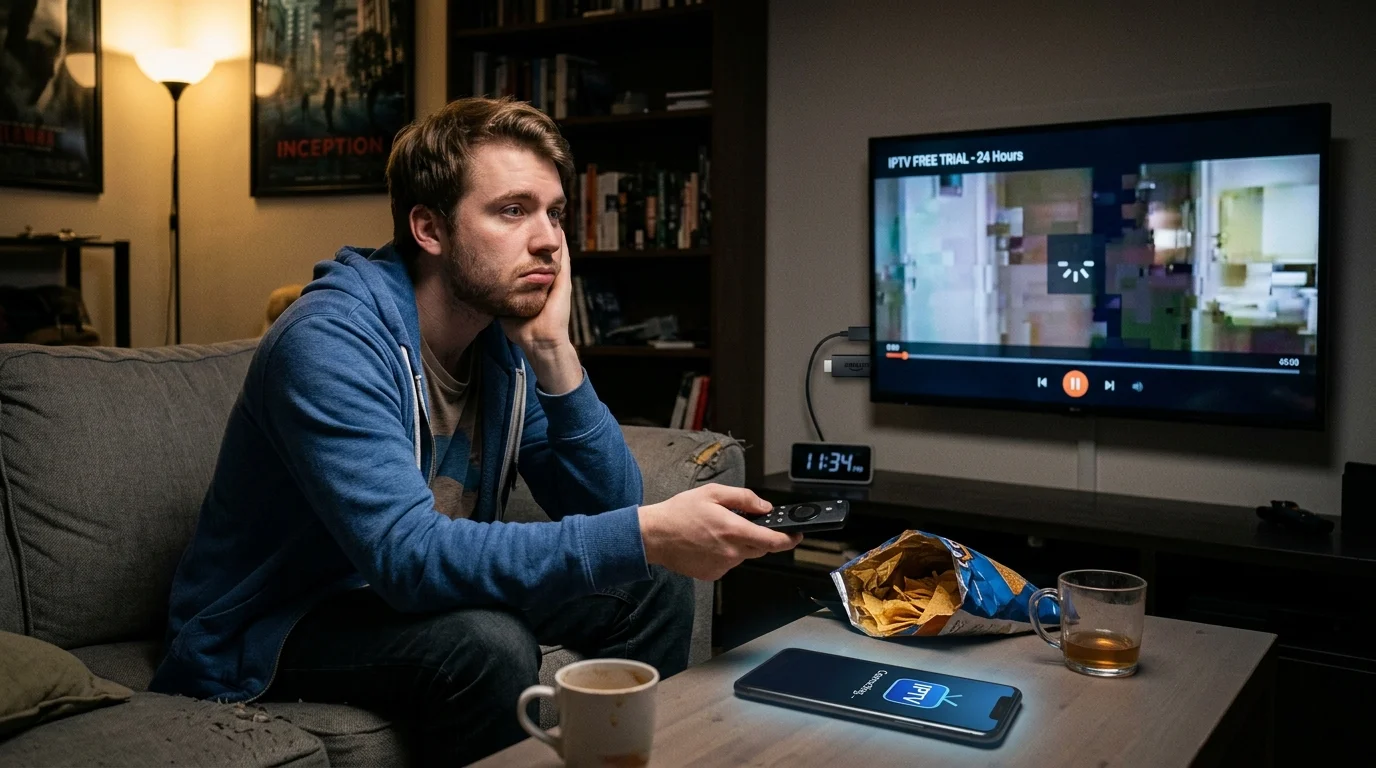
The problem with trials, in one sentence
Almost every IPTV service works perfectly at three o'clock on a Tuesday afternoon.
Demand is low, servers are quiet, and even a badly under-resourced setup delivers a flawless picture. The differences between providers only surface when several thousand people press play at the same moment — Friday and Saturday between eight and eleven, and during anything widely watched.
So a trial taken on a weekday afternoon proves the stream exists and your device can play it. It does not begin to test the thing that actually varies between services. A trial that never crosses a peak evening has told you almost nothing.
What a trial genuinely tests well
That said, plenty of useful things are immediate and binary, and a short trial answers them properly. It is worth knowing which they are.
- Device compatibility. Does your player install and run on your actual hardware? Immediate, and either it does or it doesn't.
- Audio and subtitle formats. Whether your device decodes the audio and displays the subtitles on live channels is a fixed property of your setup — and one of the most common disappointments. Our guides to why subtitles don't show cover why this varies so much by player.
- Whether your channels are there. Write down the fifteen or twenty you actually watch and open each one. Present or absent, no ambiguity.
- The programme guide. Does it load, is it complete, is it on the right time?
- The on-demand library's condition. Play five titles at random. Our guide to judging a VOD library properly sets out the five checks.
All of that can be settled in half an hour, and it is genuinely valuable — a service can fail any of these tests and be wrong for you regardless of how well its servers perform.
What no trial can prove
Four things need weeks rather than hours, and they are the four that decide whether you will still be happy in month three.
Peak-time stability. Not one evening — several. A single good Saturday is luck; four consecutive good Saturdays is capacity.
Time to restore after a fault. Every service loses a channel occasionally. What separates them is whether it comes back in twenty minutes or never. You cannot observe that until something breaks, which by definition you cannot schedule.
Support that stays responsive. A reply during a trial is a sales interaction. The meaningful test is how quickly they answer in week six, when you are no longer a prospect.
Catalogue stability. Whether the library is being maintained or quietly rotting shows up over months, not days.
Why many providers don't offer one
The absence of a free trial gets treated as suspicious, and usually isn't. Two straightforward reasons explain it.
Access costs money from the first minute. A trial consumes exactly the same bandwidth as a paying customer, and bandwidth is a recurring cost proportional to how many people are watching. Free access at scale is a real expense, not a marketing freebie.
Trials are heavily abused. In a market where signing up costs nothing, a meaningful share of trial requests are people cycling through providers indefinitely rather than evaluating one. Providers respond by shortening trials to the point of uselessness, or dropping them.
Which produces a slightly perverse outcome: the trials that survive are often too short to test anything that matters. A twenty-four hour trial that lands on a Wednesday is not evidence.
The honest comparison: trial versus short plan
Set the two side by side and the answer is not close.
| 24-hour trial | Three-month plan | |
|---|---|---|
| Cost | Free | From £24.99 |
| Peak evenings covered | 0 or 1 | Around 26 |
| Can you observe a fault being fixed? | Almost never | Yes |
| Tests post-sale support? | No | Yes |
| Tests catalogue upkeep? | No | Yes |
Twenty-six weekend evenings against one. For roughly twenty-five pounds, a short plan buys you the only evidence that actually predicts how a service will behave — and if it fails, a guarantee period exists precisely for that situation.
That is the reasoning behind our own approach. Rather than a brief trial, our 7-day satisfaction guarantee covers the period in which a real problem would show itself, on a real setup, across a real weekend. It is a longer and more honest test than any twenty-four hour window.
If you do take a trial, use it properly
Trials are still worth taking when offered. Just extract everything they can give you.
- Time it to land on a Friday or Saturday evening. If you cannot, most of its value has already gone.
- Use your real setup — the actual television, in the actual room, on the actual Wi-Fi. Testing on a laptop next to the router proves nothing about the bedroom.
- Run your channel list rather than browsing at random.
- Watch one thing for twenty minutes instead of flicking about. Stutters cluster; two minutes won't find them.
- Ask support a specific technical question and time the reply.
- Check the audio and subtitles on live channels, not just on a film.
Our guide to testing a service before you pay sets the full protocol out in detail, and it applies whether you are on a trial or a paid plan.
Two things to watch for
A "free" trial that wants your card details. If a trial requires a payment method up front, find out exactly what happens at the end of it. A trial that converts automatically into a paid subscription is a subscription with a delayed start, and the word free is doing a lot of work. Ours is not that arrangement — there is no stored payment method to convert, as our guide to what happens when a subscription expires explains.
A trial is evidence about the trial. It tells you what you experienced during those hours. Extrapolating from one quiet afternoon to a busy season is the mistake this entire article is about, and it applies equally to a paid plan tested badly.
In short
A free trial answers the immediate, binary questions well: does it install, do your channels exist, does the guide load, does your device handle the audio and subtitles. Settle all of that in half an hour and you have got real value from it.
It cannot answer the questions that decide whether you will still be happy later — peak-time stability across several weekends, how quickly a fault gets fixed, whether support still replies once you have paid, and whether the catalogue is being maintained.
So take a trial if one is offered, time it to land on a Saturday night, and treat it as a compatibility check rather than a verdict. For the actual verdict, a short plan covering twenty-odd weekend evenings costs about twenty-five pounds and tells you something a free afternoon never can.
Frequently asked questions
Yes, as a compatibility check rather than a verdict. It answers the immediate questions well — whether the player runs on your device, whether your channels are there, whether the guide loads and whether your hardware handles the audio and subtitles. It cannot tell you how the service behaves under load, which is the thing that actually varies between providers.
Because almost every service works perfectly then. Demand is low and even a badly under-resourced setup delivers a flawless picture. Differences appear when thousands of people press play at once, which in the UK means Friday and Saturday between eight and eleven. A trial that never crosses a peak evening has tested nothing that varies.
No. Trial access consumes the same bandwidth as a paying customer, and bandwidth is a recurring cost — so free access at scale is a genuine expense rather than a marketing freebie. Trials are also heavily abused by people cycling between providers. A guarantee period on a short paid plan achieves the same thing more honestly.
For anything that matters, yes. A twenty-four hour trial covers at most one evening and possibly none; a three-month plan covers around twenty-six weekend evenings, lets you see a fault actually being fixed, and tests whether support still replies once you have paid. For about twenty-five pounds that is the only evidence that predicts anything.
Use your real setup, not a laptop beside the router. Run through the fifteen or twenty channels you genuinely watch, check the guide loads at the right times, play five on-demand titles at random, and confirm audio and subtitles work on live channels rather than only on films. Then watch one thing for twenty minutes instead of flicking about, since stutters cluster.
Find out exactly what happens when it ends before you do. A trial that converts automatically into a paid subscription is really a subscription with a delayed start, and the word free is doing a lot of work. If you cannot get a clear answer in writing about what happens on the final day, that is your answer.