
Cheap IPTV UK: what gets cut to reach that price
Wanting to pay less is entirely reasonable — that is the whole point of leaving an expensive TV package behind. But there is a difference between a good price and an impossible one. When a service is offered at a fraction of what the rest of the market charges, for an identical claimed catalogue, something has been reduced. This guide explains exactly what, why it is invisible when you sign up, and how to pay less without ending up with a service that fails on the evenings you actually want it.
What it actually costs to run an IPTV service
To judge a price you need to know what sits behind it. Four things cost money, continuously:
- Servers and bandwidth — by far the largest expense, and it scales with how many people watch at once rather than how many have signed up.
- Catalogue maintenance — sources change constantly. Keeping channels alive and correctly categorised is ongoing work, not a one-off setup.
- Programme guide data — the EPG is supplied and maintained separately from the channels themselves.
- Support staff — real people answering messages, particularly at evenings and weekends, which is when problems actually surface.
None of these are optional. A provider charging a fraction of the market rate is not more efficient at them — it has decided to spend less on at least one.
The first thing cut, every time
Peak capacity. It is the largest ongoing cost and the easiest to reduce, because the shortfall is invisible for most of the week.
Here is the mechanism. A programme watched by a scattered audience across an evening places modest demand on any infrastructure. A major live event concentrates an enormous audience into the same second. Handling that peak means keeping spare headroom that sits idle from Monday to Friday and bandwidth contracts sized for the worst hour rather than the average one.
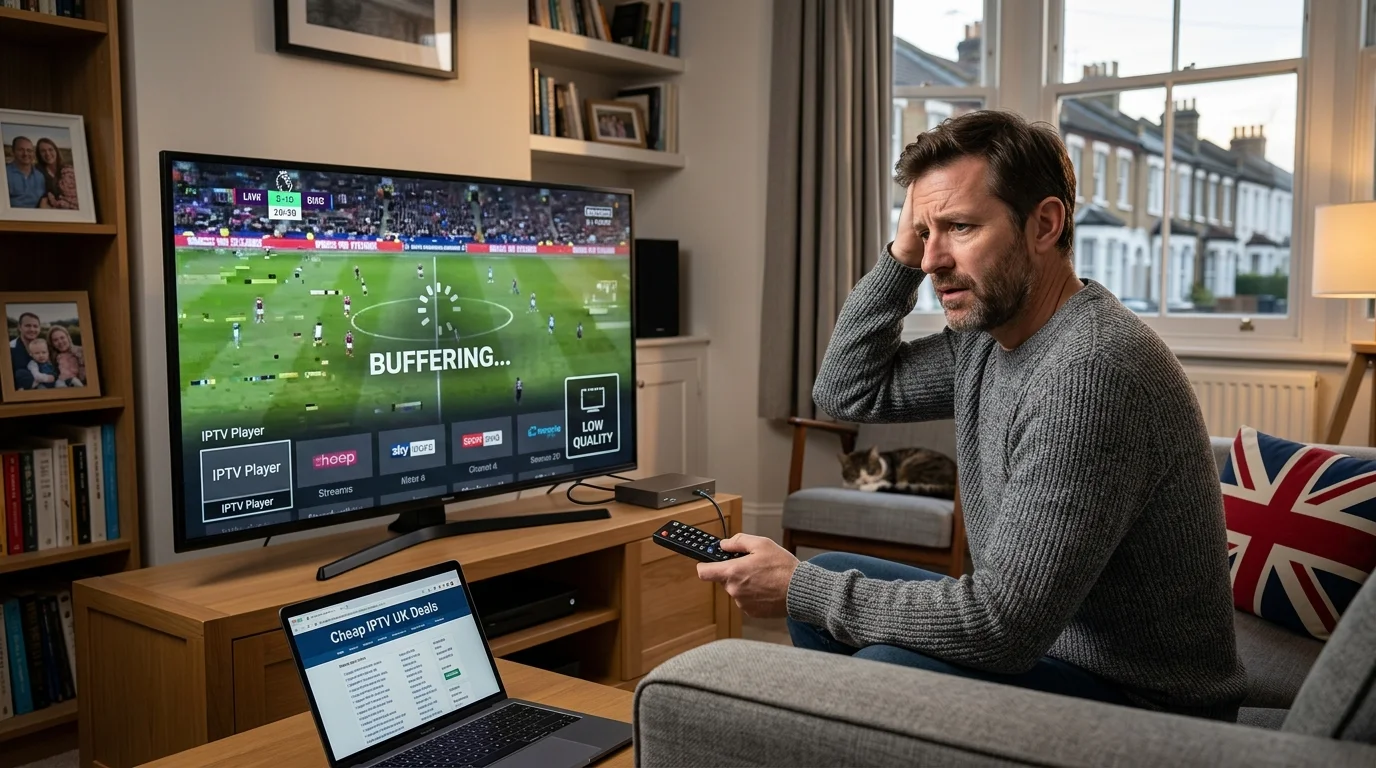
Cut it, and nothing appears to change. The service still works at three o'clock on a Tuesday. It still works when you test it the afternoon you sign up. Then a big event arrives, everyone connects at once, and the picture freezes.
That is why cheap IPTV so often feels like a bait-and-switch when it is simply arithmetic. The provider did not lie about the channel count; it just cannot serve them all simultaneously.
This is also why the test that matters is a busy Saturday evening rather than a quiet afternoon — covered properly in our guide to testing a service before you pay.
Three other things that quietly disappear
The programme guide
An EPG costs money to license and maintain. Skip it and you get a service where every channel works but the guide is empty, several hours out, or shows the wrong programme entirely.
People rarely think to check this before subscribing, and then interact with it every single evening. It is the most under-weighted feature in the whole market.
Catalogue upkeep
This is where inflated channel counts come from. A list of 100,000 entries where a large share no longer work costs almost nothing to advertise. Maintaining 20,000 that all function costs real, continuous effort.
Far more useful than the headline total: whether the categories you actually care about are properly populated and organised.
Support
The cheapest cut of all, because its absence only shows once you have paid. Support that replies on a Tuesday morning and goes silent on a Saturday night is support that does not exist when you need it.
The "lifetime subscription" arithmetic
The cheapest offer of all deserves its own section, because the maths is short and conclusive.
Costs are ongoing — servers, bandwidth, staff, every month, indefinitely. A single upfront payment against unlimited future costs is not a business model but a countdown. The money funds the service until it runs out, and it runs out sooner as more people join.
It is not always a deliberate fraud. Sometimes it is simply someone who has not done the sums. The outcome for you is identical: the service works, then one day it does not, and there is nobody to contact.
The same warning applies to hardware sold with a lifetime subscription included. You are buying a modest box at a large markup, plus a promise with no mechanism behind it.
What a realistic UK price looks like
The market sits broadly around £25 for a starter plan, with longer subscriptions bringing the monthly equivalent down considerably — often to roughly £4 a month on an annual plan.
That range is not a cartel. It reflects what the underlying infrastructure costs when it is actually provisioned for peak demand.
Below it, the question is not whether the provider is cutting corners but which corner. And above it, be equally sceptical: paying substantially more buys you very little in a market where catalogues are broadly comparable. What you are buying at any price is capacity and support, not channel numbers — a point we set out in detail in what an IPTV subscription actually includes.
The false economy, in numbers
Suppose you pay £15 for a year with a very cheap provider instead of £50 with an established one. You have saved £35 — provided it lasts.
If it stops working after four months, you have paid £15 for a third of a year, then need to buy again. You are now out roughly £15 plus the cost of a proper subscription, having spent an evening reconfiguring every device in the house.
And that is the benign outcome. The bad one is a provider that takes payment and disappears — where the money is gone entirely unless you paid by a reversible method.
The saving is real only if the service survives the period you paid for. On a very cheap plan, that is the part you cannot verify in advance.
How to genuinely pay less
There are two legitimate levers, and neither involves reducing the infrastructure behind your service.
1. Choose a longer plan — once you have tested the provider
A twelve-month subscription costs far less per month than a three-month one, and the discount is real rather than a corner cut: the provider's own costs per subscriber fall too, so nothing is being taken away from you.
The order matters, though. Start short, confirm the service across two or three weekends, then commit. A shorter plan costs a little more per month and buys you the ability to leave, which is the actual protection in this market.
2. Buy only the connections you need
Plans are priced by simultaneous connections. Count the screens that realistically play at the same moment on a busy evening — not the number of devices you own, which is usually unlimited.
Many households buy for three screens and use one. If that is you, a single-connection plan is a genuine saving with no downside.
What does not work
Sharing credentials with friends or family outside your household to split the cost. It breaches most providers' terms, produces disconnections when two people watch at once, and typically ends in suspension without a refund. It is the most common way people lose money in this market while believing they are saving it.
Paying safely, whatever the price
This matters more on a cheap plan than an expensive one, because the risk of non-delivery is higher.
Pay by card. Card payments — debit or credit — give you access to the chargeback process, which lets your bank attempt to reverse a payment where a service was not provided. There is typically a window of around 120 days from the transaction, so contact your bank promptly rather than waiting to see whether the service comes back.
Note that Section 75 of the Consumer Credit Act, which makes a credit card provider jointly liable with the seller, only applies where the item costs more than £100 — so a £25 subscription does not reach it, though an annual plan paid upfront sometimes does.
Avoid bank transfer and cryptocurrency. Neither has a reversal mechanism, by design. A provider that accepts only these has chosen methods you cannot undo, and that choice is information in itself.
Never pay in gift cards or vouchers. There is no legitimate reason for a subscription service to want them.
Finally, check that a refund policy exists and says something specific. Ours is set out on the refund policy page — not because you will read it, but because a provider that has not written one has not thought about what happens when things go wrong.
A quick checklist before you buy a cheap plan
- Is the price within the normal UK range, or a fraction of it?
- Does the offer include a working programme guide?
- Have you messaged support — on an evening or weekend — and received a reply from a human?
- Can you pay by card?
- Do the legal pages exist and say something specific?
- Is the offer free of impossible claims — no "everything in 4K", no "lifetime", no "guaranteed zero buffering"?
A no to the last three is enough to walk away regardless of the price.
In short
Cheap is not the problem. Impossibly cheap is, because the difference has to come from somewhere — and it comes first from the peak capacity you will not miss until the evening you most want it.
Pay less the sound way: test a provider properly on a short plan, then move to a longer one, and buy only the connections your household actually uses at the same time. Pay by card. And treat a lifetime subscription as what it is — a countdown with a price tag.
More on choosing and setting up a service in our other IPTV guides.
Frequently asked questions
The UK market sits broadly around £25 for a starter plan, with annual plans bringing the monthly equivalent down to roughly £4. That is the normal range. A service priced far below it for the same claimed catalogue has reduced something, and it is usually server capacity.
No. Paying less through a longer subscription period is perfectly sound, because the provider's costs per month fall too. What is different is a provider charging a fraction of the whole market for an identical claimed service — that difference has to come from somewhere.
Peak capacity is the largest ongoing cost of running an IPTV service and the easiest to cut, because the shortfall is invisible for most of the week. A service running on thin infrastructure looks flawless on a Tuesday afternoon and collapses on a Saturday evening.
No. Running a service costs money continuously, so a single upfront payment against unlimited future costs is not a business model but a countdown. It lasts as long as the operator chooses to keep paying, which is generally until new lifetime payments slow down.
Choose a longer plan with a provider you have already tested, and buy only the number of simultaneous connections you genuinely need. Both reduce your cost without reducing the infrastructure behind the service.
A card. Card payments give you a route back through the chargeback process if a service is never delivered, typically within about 120 days of the transaction. Bank transfer and cryptocurrency offer no reversal mechanism by design.